Key Takeaways
The Problem: Thousands of schools, churches, village halls, and community centres across Kent are built on Granwood composite block flooring—a unique, historically significant material that was the industry standard for institutional buildings from the 1930s through to the 1980s. After decades of heavy use, these floors are often in a dire state: worn, faded, cracked, and coated in layer upon layer of old wax, polish, and industrial sealant. Many facility managers in Kent assume the only option is to rip up the Granwood and replace it with modern vinyl or laminate—an enormously disruptive and costly project that also destroys a piece of the building’s heritage.
The Agitation: Granwood is not wood. It is a hydraulically pressed composite of cement powder, calcium silicate, and fine sawdust, formed into dense, incredibly hard-wearing blocks. This unique composition means it cannot be treated like conventional timber. Standard wood floor sanding techniques, grit sequences, and finishes designed for oak or pine will produce poor results—or worse, damage the material irreparably. The blocks are brittle under incorrect machine pressure, and the wrong finish will peel and flake within months. Many general flooring contractors in Kent lack the specialist knowledge to handle Granwood correctly, leading to costly failures and repeated closures of school halls and community spaces.
The Solution: Specialist Granwood floor restoration by experienced tradesmen who understand this unique material. Using adapted sanding protocols, specialist adhesives for block repair, and industrial-grade finishes that bond correctly to the composite surface, a Granwood floor can be restored to its original warm, golden appearance—compliant with current safety standards and ready to serve another generation. This technical guide details the professional approach to Granwood restoration in Kent’s institutional buildings.
What Is Granwood Flooring and Why Does It Matter?
Granwood flooring was invented in the early 1900s and rapidly became the flooring of choice for UK public buildings. The blocks were manufactured by combining sawdust, cement powder, calcium silicate, and fillers, which were then hydraulically press-formed under enormous pressure into dense, uniform blocks. The result was a material that combined the warm aesthetic of timber with the durability and fire resistance of concrete—perfect for schools, churches, and public halls where thousands of feet would tread daily for decades.
Across Kent, Granwood floors are found in primary and secondary schools from Dartford to Dover, in village halls throughout the Weald, in church annexes across Canterbury, and in community centres from Gravesend to Folkestone. Many of these floors are 50 to 80 years old and remain structurally sound—a testament to the material’s extraordinary durability. The challenge is cosmetic: decades of industrial polish, rubber sole marks, gym equipment scuffs, and general wear have left these floors looking exhausted.
The Unique Sanding Challenges of Granwood
Sanding Granwood requires a fundamentally different approach to sanding solid timber. Understanding these differences is what separates a specialist restoration from a botched job.
Dust Composition and Health Considerations
Unlike timber dust, Granwood sanding dust contains silica particles from the cement and calcium silicate components. This creates a significant health consideration that demands proper dust extraction. We use Bona Dust Care vacuum systems connected directly to our sanding machines, capturing over 99% of airborne particulates at source. In school environments, this is not optional—it is a legal requirement under COSHH (Control of Substances Hazardous to Health) regulations. Our dust-free setup means classrooms adjacent to the hall can often remain in use during the restoration, minimising disruption to the school timetable.
Machine Selection and Pressure Control
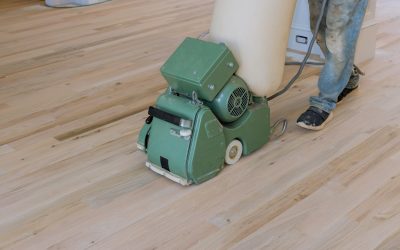
Granwood blocks are harder than softwood but more brittle than dense hardwoods like oak or maple. A heavy drum sander running at full pressure can crack or chip individual blocks, particularly at the edges where the hydraulic pressing was less uniform. We use the Bona Belt with reduced drum pressure for the main body of the floor, combined with the Frank Spider multi-disc edger for perimeters. The Frank Spider’s planetary disc action distributes pressure evenly across the composite surface, eliminating the risk of localised chipping that a traditional edge sander can cause.
Grit Sequencing for Granwood Composite
The grit sequence for Granwood differs significantly from solid timber protocols. The goal is to remove old finishes and level the surface without grinding into the composite matrix itself.
- 40-grit Zirconia (Heavy Cut): The initial pass removes decades of built-up industrial wax, polish, and old sealant. Zirconia’s heat resistance is essential here—old thermoplastic polishes can melt and clog standard Aluminium Oxide belts within minutes. We sand at a 10-degree diagonal to the block pattern to ensure even removal across the tessellated surface.
- 60-grit Aluminium Oxide: Once the old finish is stripped, we switch to standard abrasives for the levelling pass. This removes any remaining finish residue and begins to smooth the composite surface.
- 80-grit Aluminium Oxide: The refinement pass creates a uniform, smooth surface ready for the primer coat. We do not go finer than 80-grit on Granwood—the composite surface becomes too polished for proper finish adhesion beyond this point.
Pro-Tip: The 80-Grit Ceiling. One of the most common mistakes made by general contractors on Granwood is sanding to 100-grit or finer. Unlike timber, where finer grits improve finish absorption, Granwood’s cement-based surface becomes increasingly closed and non-porous at higher grits. This causes lacquer adhesion failure—the finish sits on the surface like paint on glass and peels within weeks under foot traffic. 80-grit provides the optimal balance of smoothness and mechanical ‘tooth’ for finish adhesion.
Block Repair and Replacement
In most Kent school halls and community centres, a proportion of the Granwood blocks will be damaged, cracked, or missing entirely. Repair is a critical stage that must be completed before sanding.
For cracked blocks that remain structurally intact, we inject D4-rated polyurethane adhesive into the crack lines and clamp them under weighted boards overnight. This adhesive is specifically chosen for its flexibility—rigid epoxies crack again under the micro-movements caused by seasonal temperature changes in large halls.
For missing or irreparably damaged blocks, sourcing replacement Granwood is increasingly difficult as the material is no longer manufactured. We maintain a stock of salvaged Granwood blocks from demolished Kent school buildings, carefully graded by colour and density to match existing floors. Where salvaged blocks are unavailable, we fabricate custom composite fillers using a blend of fine sawdust, calcium-based cement, and pigment, pressed and cured to approximate the original Granwood density. Once sanded and sealed, these repairs are virtually indistinguishable from the surrounding original blocks.
Finishing Granwood: Industrial Lacquer Selection
Granwood demands a heavy-duty industrial finish capable of withstanding the extreme traffic volumes in institutional settings. We recommend two primary systems based on the facility’s specific requirements.
Bona Traffic HD: The Performance Standard
For school halls used for PE, assemblies, and community events, Bona Traffic HD is our default recommendation. This two-component waterborne polyurethane provides exceptional abrasion resistance, chemical resistance against cleaning products, and consistent slip characteristics that meet EN 14904 requirements for indoor sports surfaces.
Application follows our standard commercial protocol: one coat of Bona Classic UX primer followed by two coats of Bona Traffic HD, with 4-6 hours drying time between coats in a well-ventilated hall. Line markings for sports courts are applied after the first topcoat using Bona Sportive Paint, then ‘sandwiched’ beneath the final topcoat for maximum durability.
Loba 2K Supra AT: The Ultra-Durable Alternative
For exceptionally high-traffic facilities—secondary school halls used for daily PE, examinations, dining, and evening community events—we sometimes specify Loba 2K Supra AT. This ceramic-reinforced two-component polyurethane lacquer offers what may be the highest scratch resistance of any waterborne floor finish currently available in the UK. The ceramic particles embedded in the film create a surface that withstands chair legs, shoe grit, and cleaning machines far longer than standard lacquers. Coverage is approximately 8-10m² per litre, with full cure achieved in 5-7 days.
Pro-Tip: Temperature Matters During Application. Both Bona Traffic HD and Loba Supra AT require ambient temperatures between 15°C and 25°C during application and curing. In Kent’s unheated school halls, this can be problematic during winter restoration projects scheduled for the Christmas or Easter holidays. We bring industrial dehumidifiers and fan heaters to maintain optimal conditions, monitoring temperature and humidity hourly throughout the curing window. Applying lacquer below 15°C causes grain raising in the composite surface and dramatically slows the chemical cross-linking process, resulting in a softer, less durable finish.
Project Planning: Working Within School Schedules
Granwood restoration in Kent schools is almost always scheduled during holiday periods to minimise disruption. A typical primary school hall (approximately 150-250m²) requires 5-7 working days from initial sanding to final cure. Secondary school sports halls (400-800m²) typically require 7-12 working days depending on the extent of block repairs needed.
We work closely with Kent school facility managers to plan projects around term dates, half-terms, and INSET days. For larger projects, we can phase the work—sanding and repairing during one holiday period and finishing during the next—to accommodate particularly tight schedules.
Ongoing Maintenance: Extending the Restoration
A properly restored Granwood floor with a two-coat Bona Traffic HD finish should last 5-8 years in a busy school environment before requiring attention. To maximise this lifespan, we recommend:
- Weekly mechanical buffing with a white polishing pad to remove embedded grit and surface scuffs.
- pH-neutral cleaning only—never bleach, vinegar, or abrasive cleaning solutions, which attack the lacquer film.
- Entrance matting: Industrial-grade barrier mats at all entry points reduce grit ingress by up to 80%, dramatically extending finish life.
- Screen and recoat every 3-4 years: A light mechanical abrasion of the existing lacquer surface followed by a single fresh topcoat maintains the protective film without the cost and disruption of a full sand-back.
Conclusion: Preserving a Unique Heritage Material
Granwood flooring represents a fascinating chapter in British building history—a material engineered for durability that has outlived its own manufacturer. Professional restoration is not merely a cosmetic exercise; it preserves the character of Kent’s institutional buildings whilst delivering a safe, compliant, and beautiful floor for modern use. For facility managers, school governors, and parish councils across Kent seeking specialist Granwood restoration, our team brings decades of composite flooring experience to every project. Explore our guide to heritage finish sheens for churches for related advice, or contact Kent Floor Sanding for a free commercial site survey and detailed quotation.